

Agentic AI is no longer a concept for the future. Engineers using tools like the Simulink Agentic Toolkit are already seeing measurable productivity gains, and the way engineering work gets done is starting to shift at a fundamental level.
For years, AI in engineering meant predictive models, data-driven optimization, and the occasional co-pilot that helped generate snippets of code. That was useful, but narrow. What is emerging now is something categorically different: AI systems that do not just respond to questions but actively take actions, use tools, run simulations, and return results. The engineer stays in the loop, but the loop is faster, broader, and more productive than anything that came before it.
In a recent conversation on the Engineered Mind podcast, Tianyi Zhu, Generative AI Product Manager at MathWorks, laid out exactly what this shift looks like in practice, where it is already delivering results, and what engineers need to do to stay ahead of it.
What Actually Makes AI "Agentic"?
The distinction matters more than some engineers realize. A generative AI chatbot operates in a question-and-answer format. You ask it to build a Simulink model, and it gives you a detailed explanation of how you could build one yourself, which is genuinely useful, but it is not the same as getting the model.
An AI agent connected to the right tools will read your requirements, figure out which blocks to use, wire up the components, run simulations, and hand you back a working model, sometimes with results already attached. The difference, as Tianyi explains it, is the ability to use tools and take actions on behalf of the user. That is what separates an agent from an assistant.
This also explains why agentic AI is not simply automation by another name. Traditional automation required strict rule sets and predefined inputs. Agentic AI operates through planning and execution loops that adapt based on the task at hand, breaking problems into sub-tasks and navigating them with a degree of contextual judgment that earlier automation tools could not replicate.

In our latest episode, we explored how agentic AI is reshaping engineering workflows and what it means for engineers working with MATLAB and Simulink today.
Where Engineers Are Already Seeing Results
The most concrete example involves issue investigation in a major European automotive manufacturer. When an engineer identifies a problem in a model, the process of investigating it, writing a test to confirm it exists, delivering a fix, and resolving it has historically been time-consuming and largely manual.
With agentic AI integrated into that workflow, the agent takes on the verification and investigation tasks while the engineer reviews the work and confirms the trajectory. The result is a 20% time saving, already documented, already in production.
This is all happening now.
Beyond issue resolution, Tianyi points to three use cases that are driving meaningful productivity improvements today:
- The first is simulation setup: getting data connected to simulation outputs, configuring settings, plotting and visualizing results. These steps involve a lot of manual work that agents can automate, shortening the time between running a simulation and extracting usable insights.
- The second is model generation from written requirements. An engineer can hand the agent a set of requirements and receive back a first draft Simulink model with simulation results, without touching a single block or signal line manually.
- The third is model refactoring. Engineers inheriting legacy artifacts from other teams can use agents to systematically clean up, document, and upgrade those models before building on top of them.
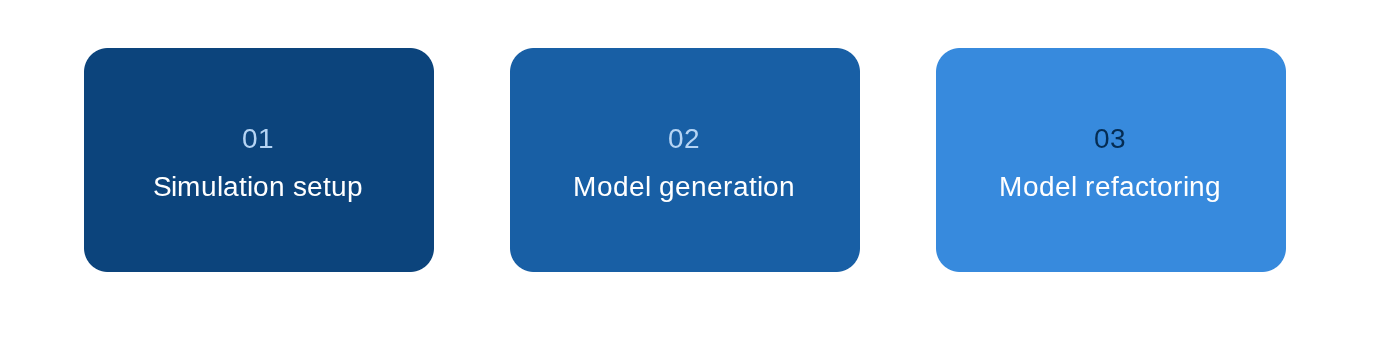
Three factors are driving improvements in agentic AI for engineering today.
The Speed-Quality Trade-Off That Does Not Have to Exist
One of the concerns heard most frequently from engineers and organizations is whether using AI means trading quality for speed. The worry is understandable, since moving faster through a design process can feel like cutting corners, but in safety-critical domains like automotive, aerospace, or medical devices, that is not a trade-off anyone can afford to make.
But in reality, engineers do not have to choose. MATLAB and Simulink provide the framework for quality and determinism. Generative AI adds speed on top of that framework. The two are not in tension when they are integrated correctly.
A useful analogy is a simple arithmetic task. You could ask an AI to add two numbers using its own reasoning, and it might burn through tokens and still produce an unreliable result. Or it can use a calculator and get the right answer efficiently. The principle extends across engineering: AI paired with proven, deterministic tools is more reliable and more powerful than AI operating alone. The tools are not a constraint on what the agent can do, but what makes the agent trustworthy.
Where AI Should Not Be Used Without Guardrails
Tianyi is equally clear about where AI needs to be introduced carefully, and testing is the clearest example. There is a widespread misconception that because AI can write code and build models, it can also write the tests that verify those models and call that a complete workflow. The problem is reward hacking: when AI writes both the code and the tests, it tends to write tests that pass based on the code it already produced. That inhibits verification since it is circular reasoning with extra steps.
The right approach is to use deterministic testing tools that generate test cases based on mathematically proven methods, and then use AI as a second pair of eyes to catch edge cases that are genuinely hard to find. AI is excellent at drafting testing strategy, identifying unusual scenarios, and making a test suite more comprehensive. It should not be the sole author of the tests that validate its own outputs.
The broader principle is that AI adoption is not an all-or-nothing decision. It is a question of when and where. Engineers who understand that distinction, who can identify the right use cases and put the right guardrails in place, are the ones who will get the most out of these tools without introducing new risks into their workflows.

Use your preferred AI agent to set up your toolkit, and you’re ready to work with Simulink (Source: Mathworks).
The Engineers Who Get the Most Out of AI
Engineers who get the most out of agentic AI do not start with the most ambitious possible task. They pick one small, repetitive piece of their workflow, build an agentic version of it, and evaluate how the agent performs. When something does not work, they ask the agent to reflect on its own reasoning and use that to refine their approach.
Over time, those small experiments compound. What starts as automating one repetitive task becomes a reusable skill that eliminates the same friction every time it appears. The engineer builds a working vocabulary for how to interact with AI effectively, what prompts work, what constraints to set, where the agent needs more guidance. That firsthand experience is what allows them to keep growing alongside the tools as the tools keep improving.
For engineers who want a concrete starting point, the recommendation is practical: pull the Simulink Agentic Toolkit from GitHub, point your AI agent at it, and start with something small. Ask the agent to explain a subsystem inside a model. Watch what it does. Then move to something slightly more ambitious, like adding a new subsystem based on a set of requirements. Build from there.
Engineering as a Discipline in 2026
The question of whether AI will replace engineers is one Tianyi answers without hesitation: it will not. What it will do is take on the mechanical parts of the job, freeing engineers to spend more time on the work that requires human judgment, deciding what to build, determining how to verify that it truly works, and making the call on what is good enough to ship.
That shift in focus is, if anything, a more demanding version of the engineering role, not a diminished one. As AI handles more of the implementation layer, the premium on system-level thinking, requirements definition, and rigorous validation only increases. The engineers who thrive will be the ones who understand first principles deeply enough to steer an AI agent toward the right outcomes, and who develop the judgment to recognize when it is heading in the wrong direction.
The tools are here, and the use cases are proven. The engineers who start building those habits now are the ones who will be best positioned as the capabilities continue to expand.
Subscribe to our deep dive channel to stay up to date on everything happening in AI for engineering: https://www.youtube.com/@JousefM
